


Calligraphy - How long does it take to learn
How long does it take to learn calligraphy
Calligraphy is an ancient art that has impressed with its beauty and precision for centuries.
Nowadays, more and more things are being digitised. That's why hand calligraphy has become something special and unique. But there is often confusion and misunderstanding about what we are actually buying when we are looking for calligraphy. It is therefore important to have a clear understanding of the difference between real calligraphy, digital calligraphy, fonts and other forms of writing, and how much time and effort it takes to master this art.

The path to calligraphy mastery
When you start learning calligraphy, you quickly realise that it is a skill that requires much more than just beautiful handwriting. In fact, it is not even necessary to learn calligraphy. In fact, calligraphy involves many layers of learning, from the correct control of the pen, to sitting posture, to the basic strokes, to forming the letters and connecting them into coherent words and sentences. Every stroke, every turn and every detail has its own meaning and contributes to the overall image of the text.
In calligraphy, it is also necessary to learn the correct proportions and the correct pitches of a single script when exploring classical calligraphic scripts.We also use some basic mathematics.
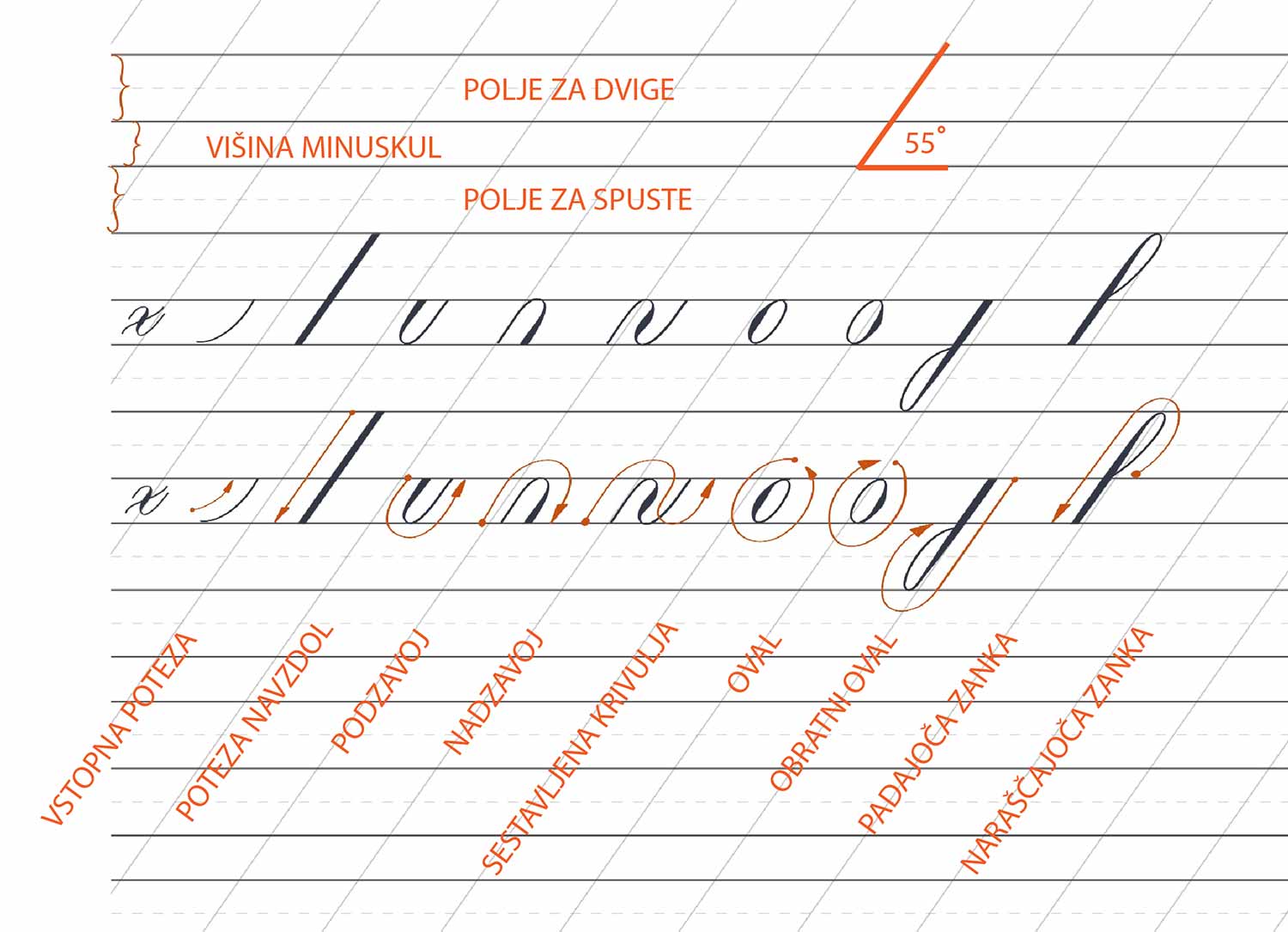
Practice is the key to success. Developing muscle memory through regular practice allows hand calligraphy to become more and more natural and fluent. It is important to understand that each calligrapher develops his or her own unique style that reflects his or her personality and artistic expression.
How long does it take? If you want to learn the basics of calligraphy, you can reach a basic level in a few months with regular practice. To achieve mastery, especially in traditional styles such as Spencerian Italian, Gothic or Roman capitals, you will need years of dedicated work. Mastery is not only a technical skill, but also a deep understanding of the history of the typeface in question, of the forms, composition and expression through the script.
What is real calligraphy and what do you actually buy when you are looking for calligraphy?
True calligraphy is the art of handwriting with different calligraphic tools, where each stroke reflects the artist's mastery and precision. The use of different line thicknesses and dynamic strokes creates words that are not only aesthetically sophisticated but also rich in expression. Calligraphy can be traditional, where strict adherence is made to certain rules that have evolved over the centuries, or contemporary, where the artist explores new forms, experiments with spatial arrangements and adapts the style to his own needs and inner expressiveness.
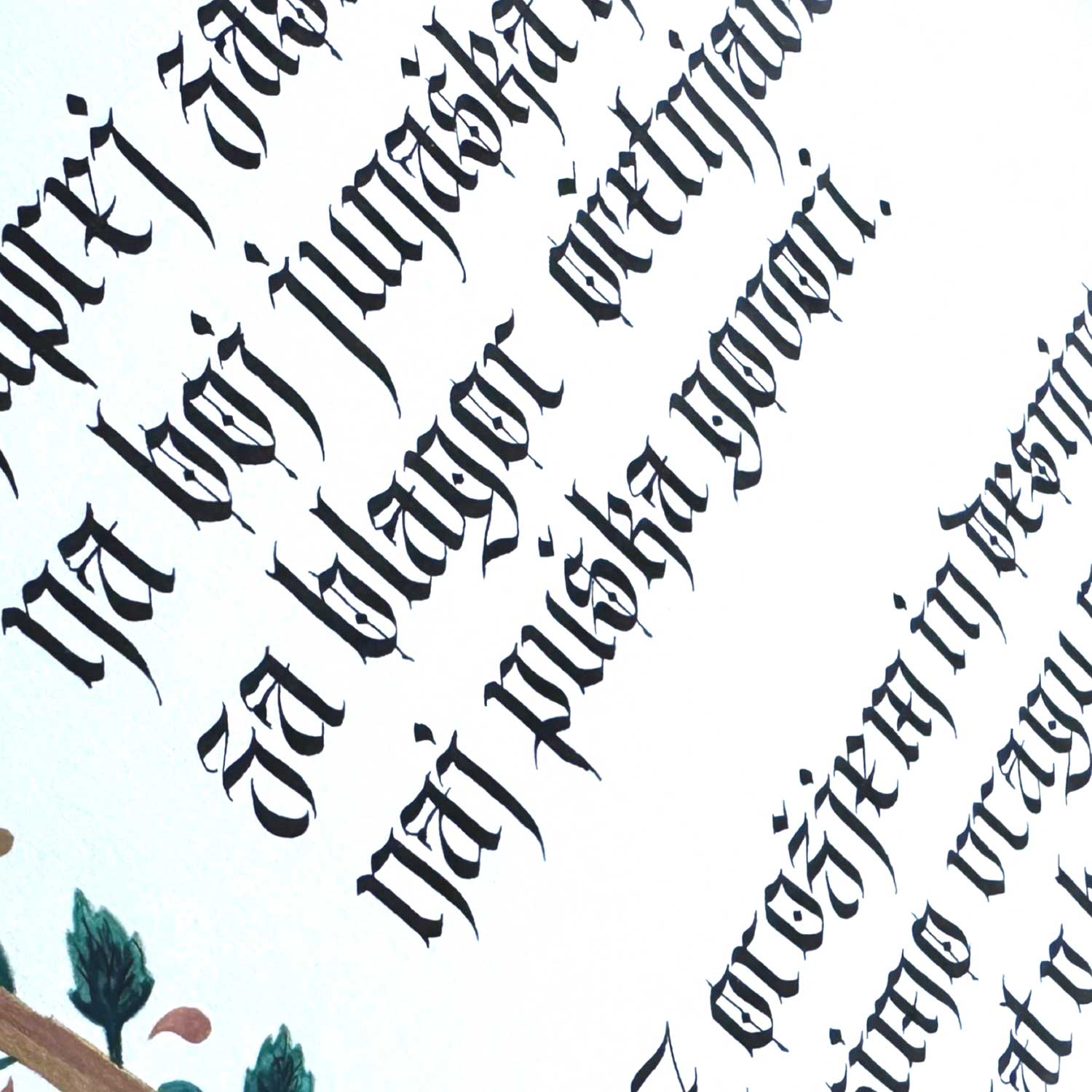
The influence of Dada in calligraphy is particularly present in contemporary approaches, where calligraphers depart from classical rules and focus on spontaneity, absurdity and subversion of established norms. Dada, as an artistic movement that challenged traditional values and aesthetics, encourages the exploration of new possibilities in calligraphy, where the letter can be a mere element of visual composition, without strict regard to legibility or meaning. Artists in spirit Dada use calligraphy as a means of expression that does not necessarily conform to conventional aesthetic values.
This process of creation, which combines traditional crafts and avant-garde approaches, requires a great deal of knowledge, skill and time, as the artist not only masters technical aspects of writing, but also understands and interprets deeper philosophical and artistic concepts.
Calligraphy legibility can therefore be completely subordinate to the artistic expression and purpose of the product - or it can be used as a means of communication, conveying a clear message, or, as in Dada, it will become part of a broader artistic composition, where the meaning of words may no longer be the central element, but merely part of a visual game.
Monograms are an art formwhere the initials of the first and last name are intertwined to form a single character, which often has decorative and symbolic value. Historically, monograms have been used as personal or family symbols, sometimes even as royal or noble seals. In modern monogram design, calligraphers are often faced with the challenge of legibility, as capital letters, especially in stylised scripts, are not always easily recognisable as they would be in a simple printed form. However, monograms do not only serve as functional inscriptions; they are often designed as visually appealing logos, where decorative value is more important than legibility. This interplay of lines and shapes creates unique patterns that exude personality and aesthetics, making the monogram more than just a symbol - it becomes a work of art.
It often happens that a client chooses a certain font for a monogram, but then gets confused by a specific letter that he cannot read and wants to change the font. However, it is important to understand that when adhering to a historically correct font, it is important to take into account its cultural and aesthetic significance. Such typefaces are often precisely designed with a particular style and historical context in mind, so adapting individual letters can compromise the overall design and its intent.
The key to calligraphy is understanding, what it is used for. If it is a monogram to serve as a symbol or decoration, stylisation is more important than legibility. In this case, the monogram is an artistic expression where an interplay of lines and shapes combine to form a visually appealing sign that is not necessarily easy to read, but carries aesthetic and symbolic value.
On the other hand, when we use printed materials to record information such as event times or telephone numbers, we need to consider the importance of good legibility.
We will not write such parts of the text in highly decorated fontsas this would reduce their usefulness and clarity. Instead, we opt for more simple, functional fonts that provide accurate and easy-to-read text. Thus, when choosing a font for a particular purpose, it is essential to always consider whether it is decorative or informative and to choose the style and approach accordingly. That is why calligraphy is more than perfect when combined with typography (computer fonts).
Digital calligraphy and handwritten fonts: what's the difference?
Also commonly used in the design world digital calligraphy, which in turn derives from true calligraphy. A calligrapher first writes the text by hand, then scans it and converts it into a digital image that can be used for a variety of purposes, such as printed materials, logos or other graphic elements. This form of work still retains all the characteristics of handwriting and is not simply a typed word.
On the contrary Italics or handwritten script created in a graphic design software often mimics the look of calligraphy, but it is not handmade. Although these fonts can be very beautiful, they cannot capture the subtlety and uniqueness that hand calligraphy brings. It is often the case that designers use the term "calligraphy" for something that is really just a computer font, even if that font is based on a handwritten script. Calligraphers also often create their own typography, which is really closer to actual calligraphy, but which is ultimately a typed text.

"Lettering" and other forms of writing
In addition to calligraphy and digital calligraphy, there is "lettering" or tracing letters, spelling. It is the drawing of letters and words by hand, not with calligraphic pens but with other tools such as pencils, markers, brushes or digital tablets. Lettering is an art form that also requires a great deal of skill and creativity, but it differs significantly from calligraphy in that it does not use the pen and ink technique.
Lettering can also include "faux calligraphy", which in Slovenian would be translated as "fake calligraphy" or "false calligraphy". It is a technique where a normal pen (such as a ballpoint pen or felt-tip pen) is used to create the appearance of real calligraphy by manually adding thicker lines in certain parts of the letters where they would otherwise be naturally thicker if written with a calligraphy pen.
The aim of this technique is to create the effect of calligraphy without the use of specialised tools, making it accessible to a wider range of people, including those who may not have experience of real calligraphy.
The importance of understanding what you are buying
When ordering wedding stationery, invitations or other special projects, it's essential to know what you're actually buying. Hand calligraphy is much more than just an aesthetically pleasing record; it is the result of hours of dedicated work, precision and artistic skill. Every element you see on my products is first carefully handwritten, then converted into digital form for printing. When you order calligraphy prints, I can assure you that each piece reflects my personal effort and craftsmanship. Of course, for unique creations, we always retain the original calligraphy, for all copies. Then we avoid digitisation, which also adds more value to the individual copy.
When a designer sells you "calligraphy", make sure it is real calligraphy. If the designer is not a calligrapher or does not work with a calligrapher, then you are not getting calligraphy, you are just getting a font, a typeface, a typography that has the appearance of a handwritten script. It is important to remember that real calligraphy carries with it the soul and expression of the artist, whereas fonts and digital inscriptions are the product of an automated process.
Distinguishing between typing text and handwriting one of the key differences is spatial complexity. Typed text is usually very compact, with the letters evenly aligned and arranged in precise lines, allowing a lot of information to be written in a small space. In contrast, handwritten text, especially in calligraphy, requires much more space. Calligraphic writings are often more sprawling, involving broad strokes, varying line thicknesses and individually shaped letters, who need their own space to express themselves.

In addition, calligraphers often incorporate other artistic elements such as flourishes, decorative patterns, initials and other aesthetic accessories, that enrich the overall design. These elements require additional space, which means that calligraphic notations usually need a larger format than simple typed text would require.
It is important to take this spatial relationship into account at the planning stage of a project, as it is often the case that a text that appears short and concise at first sight becomes much more voluminous in calligraphic form. Calligraphy is not simply the writing down of words, but an artistic expression where each element contributes to the overall composition. For this reason, more space must be allocated to allow the text to be correctly represented and for the additional visual elements to come into their own, creating a harmony between functionality and aesthetic value.

Value of manual work
In recent years, as a calligrapher, I have often faced the challenge of evaluating the handmade, especially through comparisons with typographic fonts and laser engraving. Is it really so difficult to understand that a handwritten font is tailored to the client in question? Not only is the handwritten text written only once and is therefore unrepeatable. The whole process of making and fulfilling the client's wishes, including communication about the product, is tailored to that client.
Hand calligraphy takes time, concentration and artistic skill. Every product I create is the result of years of learning and continuous improvement. If someone puts a price of EUR 0.50 on laser engraving, you really cannot expect that a handmade piece of work, which involves so much effort and personal expression, will be cheaper than typed text and the inclusion of an engraving machine or a printer. Such expectations devalue the art and the work that we as calligraphers put into each product.
Calligraphy is not a sprint, it's a marathon
While interest in calligraphy has grown in recent years, it is largely practised as a hobby. At a time when dopamine doses are within reach of a single "scroll" or key, it is hard to expect more young people to take up calligraphy as a profession. Calligraphy requires a lot of dedication and perseverance, as the results are not immediately visible. It takes time, patience and a lot of practice before the desired effects are achieved.

This process is similar to the preparation of an Olympic sprinter, who trains hard for four years to get a few seconds. In fact, it turns out that he is not only a sprinter, but also a marathon runner, as it takes long-term endurance and an unwavering will to reach the goal. Similarly, in calligraphy, the road to mastery is long and requires more than instinct gratification. In this context, the challenge of our times is how to attract young people to an activity that requires so much dedication and perseverance, when there are so many other routes to quick rewards.


No Comments