


Description
Copperplate calligraphy - Book of knowledge - PRIDE KMALU
Calligraphy is a wonderful skill that not everyone can do, but everyone can do. This knowledge book is the perfect opportunity to learn about the world of elegant fonts.
Contents of the Copperplate self-learning knowledge booklet
- Calligraphy glossary
- Posture and sitting
- Preparing to write
- Paper layout
- Pen posture - calligraphy handle
- Pen preparation - Different ways to prepare pens
- Correct positioning of the pen in the handle
- Maintenance of pens
- Letter relationships
- How to calculate the cursor fields
- Letter gradient and changes to the standard gradient
- Before writing in ink
- Basic strokes - the building blocks of letters
- Naming of moves
- Description of how to write moves
- Stroke shapes: letters are divided into four groups
- Making strokes into letters and words
- Different representations of letters and numbers: on their own, on a highlighter, with directional arrows
You can complete the booklet with all the supplies you need to turn your creative journey into a wonderful experience.
- Ink
- Peresnik level
- Oblique pen
- Nikko G flexible pointed pen - best for beginners
- Practice minuscules - the lower case letters of the alphabet
- Majuscules - capital letters of the alphabet
- Practice combining letters into words and text
Q: Why is learning calligraphy useful?
O: Here are six important reasons to learn calligraphy skills, as well as reasons why more handwriting is useful:
- Improving brain activity: Handwriting activates the brain, especially the areas responsible for language, perception and movement. By stimulating these neural circuits, handwriting can increase your cognitive function, creativity and problem-solving skills.
- Improving memory: Studies have shown that handwriting can improve memory and recall of this information learned through note-taking. By engaging your motor and cognitive processes, handwriting can help you 'encode' and store information more efficiently than typing or reading.
- Personalisation of other projects: Calligraphy skills and handwriting practice can add a personal touch to your projects, notes and written texts. By developing your own style, you can create unique and memorable creations in your work or other hobbies and produce projects that stand out.
- Motor skills: Learning calligraphy and practising handwriting can improve your fine motor skills, eye-hand coordination and manual dexterity. These skills are important not only for writing, but also for other tasks that require manual dexterity and precision, such as drawing, painting or playing an instrument.
- Meditation: Practicing calligraphy and handwriting can be a meditative activity that promotes relaxation, mindfulness and concentration. If you concentrate on the strokes, shapes and rhythms of the letters, you can enter a state that calms your mind and reduces stress.
- Artistic expression: Calligraphy and handwriting can also be a form of artistic expression that allows you to explore your creativity, style and personality. Whether you prefer traditional calligraphy styles or modern handwriting trends, you can find a way to express yourself through the beautifully written word.
- An additional reason - Impact on children with ADHD and PTSD:
Learning calligraphy has positive effects also affects children with ADHD (Attention Deficit Hyperactivity Disorder) and PTSD (Post Traumatic Stress Disorder).Studies have shown that calligraphy improves attention, sensory-perceptual acuity, cognitive and intellectual abilities, emotional stability and self-control. Calligraphy practice can help children with ADHD to improve concentration and reduce hyperactivity. Calligraphy also has a therapeutic effect on children with PTSD, reducing symptoms of hyperactivity and improving overall emotional stability. You can read more about this in the following studies:
- Dovepress - Effect of calligraphy training on hyperarousal symptoms for childhood (Dove Med Press).
- Lupine Publishers - Calligraphy Treatment of Children with ADHD: A Case Study (Lupine Publishers).

Cotton bag with calligraphic inscription. Visualisation by Zlatka Trstenjak Rampre

Copperplate Calligraphy - starter pack for self-learning - image is symbolic. Visualisation by Zlatka Trstenjak Rampre
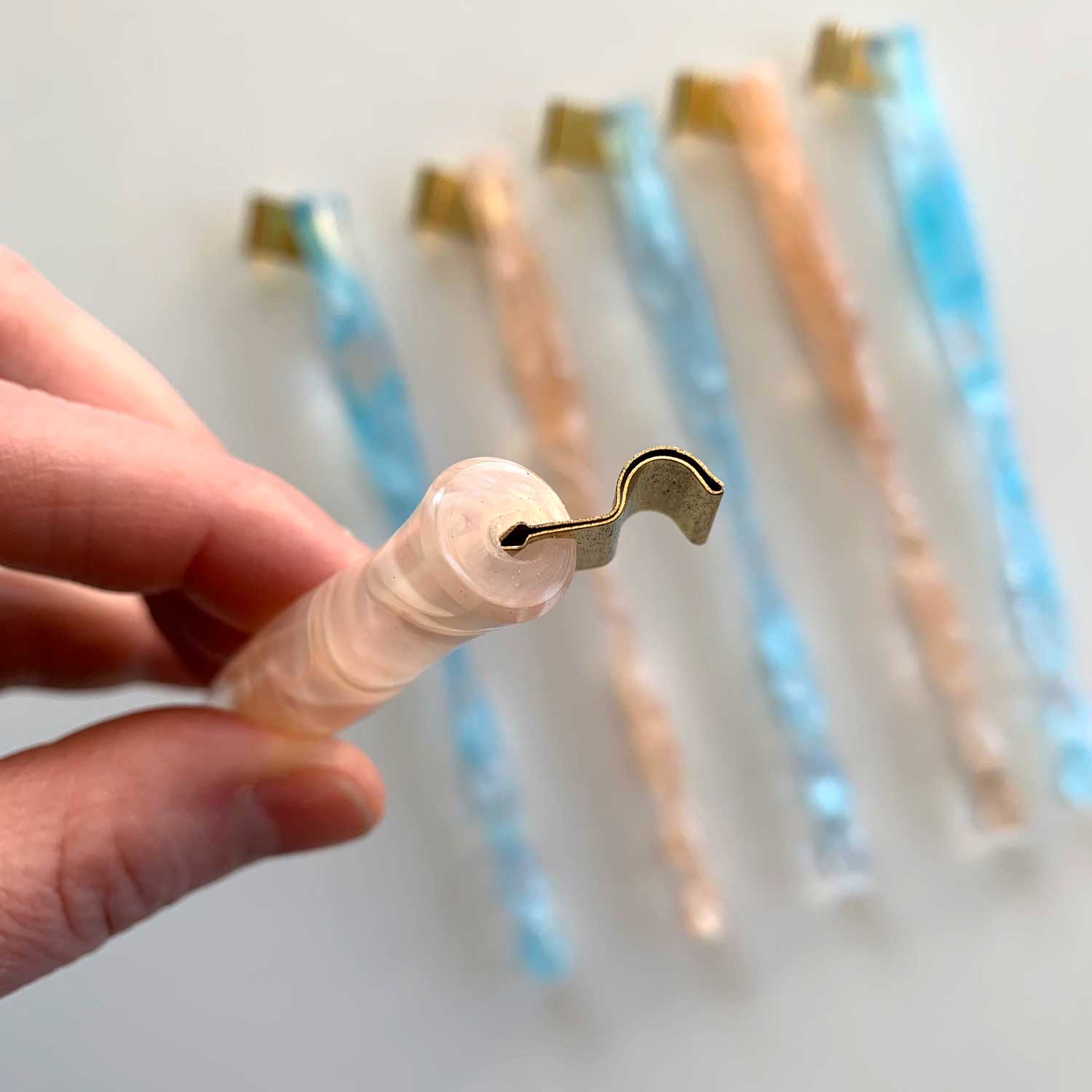
The slanted calligraphy grip of the flexible pointed pen allows us to learn Copperplate or modern calligraphy easier and faster.

Slanted calligraphy pen and correct pen setting. Avoid the nib on the right-hand side as it does not allow the correct setting of the calligraphy nib.







Reviews
There are no reviews yet.