


Calligraphy - How do we learn it?
Magical and timeless calligraphy is useful at every turn, especially on occasions that call for something romantic or unique. The first touch of paper with a calligraphic pen requires some simple but necessary preparation.
Free trial for those of you who want to test whether you are the real deal. You can do the first exercises with a pencil (I recommend a softer one like B2.
Magical and timeless, calligraphy is useful at every turn
Calligraphy is an art that brings aesthetics and meaning to everyday life, especially on occasions that call for something romantic or unique. The first touch of paper with a calligraphy pen requires some simple but necessary preparation. Calligraphy courses are therefore a wonderful way to approach this art. You can also do it as a self-taught artist. True, the path may be steeper, but you may appreciate more every little thing you learn.
How do we learn calligraphy?
Calligraphic writing can be complemented with many other pictorial and creative techniques. As we master the strokes of the different scripts, our enthusiasm and thus our desire to combine calligraphy with other skills will grow in parallel. At the same time, we will want to try out many other materials besides pen and ink for our creations to impress those closest to us.

Copperplate exercises with pencil.
Calligraphy pen
Calligraphy is not only about letters, but also about the science of materials. That authentic feeling when the pen glides across the paper is priceless. But it takes the right combination of paper, pen and ink to achieve that feeling. Calligraphy pens of different sizes and shapes can be used. From goose nibs, bamboo nibs and metal nibs for which we need a holder.
Dip the pen and the holder into ink or other paint mixtures such as watercolour, gouache or acrylic. Instead of dipping them, ink can also be applied with a brush. Ink pens are also available in specialist shops calligraphy fountain pens using ink cartridges. I do not recommend learning with a fountain pen for serious calligraphy. The choice of pen and nib depends on the script to be learnt.
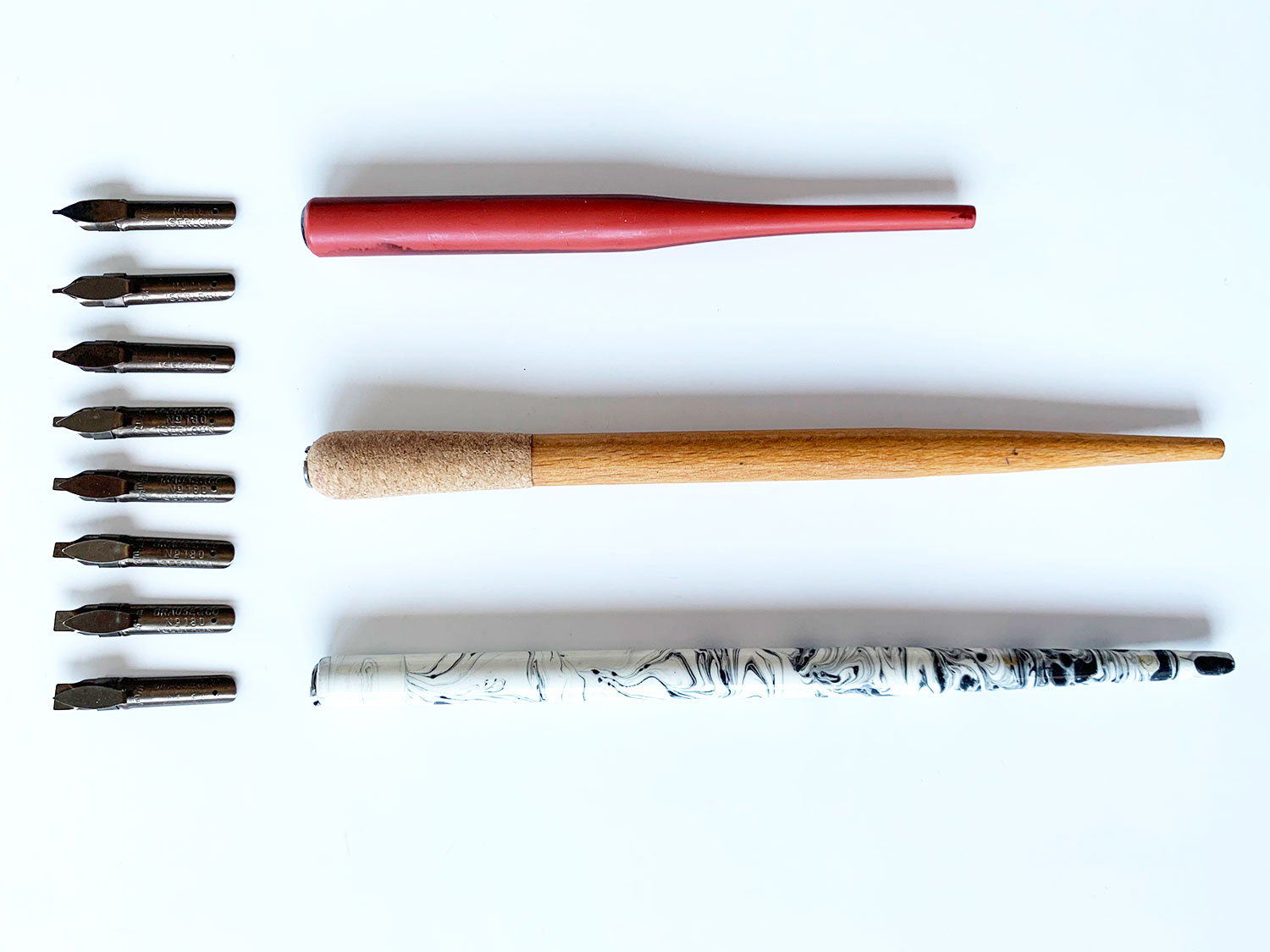
Double-width nibs for scripts such as Carolingian minuscule, Uncial, Italic and Gothic
Preparing the calligraphy pen
Calligraphy pen must be prepared before writing, as the metal treatment itself makes it slightly oily. Here I swear by saliva. Saliva does a very good job of removing this grease, but please, a pen is not a sweet. So don't put the pen in your mouth, rather put the saliva on a paper towel and dip the pen in it and gently scrub it. You can dip the pen in the paint and wipe off the first coat, then dip it in the paint again.
Some calligraphers expose the pen to the fire of a lighter for a few seconds and then dip it in cold water, which is not suitable for delicate pointed pens. Others stick it in potatoes for a few minutes, others wash it with soap or toothpaste. Of course, you can clean the nib with solutions available in calligraphy shops. However, I would advise beginners not to rush out and buy every possible accessory, because they are not that necessary.

Calligraphic pointed pen
Which calligraphy pen to choose?
Double-width pens
For our first strokes of the two-syllable fonts (uncial, Carolingian minuscule, Italian, Gothic), I suggest choosing a 2 mm or 2,5 mm wide bi-width nib, as this is the only way to see all the details of the strokes that make up each letter. The width of the nibs can vary greatly. From the narrowest, which is only 0 ½ mm, to 20 mm, which can be used for writing on larger formats that require bolder strokes. The angle at which the pen is held and the height of the letters themselves depend on the rules for writing each font.

Automatic pen for writing posters.

Calligraphy course materials.
Tapered flexible feathers
Scripts Copperplate, English Roundhand, Engrosser´s Script, Engraver´s Script, Madarasz or Spencerian request a pointed pen or English.: point penwhich splits when pressure is applied. With the right amount of pressure, this produces thin and wide lines, as increasing the pressure also increases the flow of paint. A slight upward stroke gives a thin line and a stronger downward stroke a broad line. Next to the pen you also need a suitable pen holder. For Roundhand and Copperplate we need a flat calligraphy holder, for others Calligraphic knee-holder or oblique penholder, to obtain the correct writing slant.

Calligraphic flexible pointed pen
Calligraphy pen can last longer if properly cleaned immediately after use to prevent rusting. A soft toothbrush and soapy water can help. Then dry it immediately with a kitchen paper towel. The use of the pen also depends on the ink or colour, and on what paper you are writing on. The ink weighs down the metal pen and takes the shine off it. It even burns into the nib a little, so cleaning immediately after use is very important.

Pointed pen in flat and slant grip.
Correct pen position in calligraphic handle - Peresnik.
When writing with a slanted grip, it is extremely important, that the handle is correctly shaped, as shown in the figure below. The tip of the pen should touch the apparent centre line of the handle. Unfortunately, the holder on the right side of the picture does not allow this, so I advise against it. The pen holder is closed on the other side, so the pen cannot be pushed in deep enough, which causes the pen to remain in the wrong position. You may save money in the beginning, but the incorrect position of the pen and the generally rigid shape of the grip slows down progress and can be painful to write with.
Of course, you could have chosen a shorter pen, but the Nikko G An exceptional quality calligraphy pen, perfect for beginners and experienced calligraphy enthusiasts alike. It is durable and very long-lasting.

Slanted calligraphy handle and correct setting.

PILOT calligraphy fountain pens.
Inks and colours
Popular use is Chinese or Japanese ink in sticksdissolved in water. You can also use bottled showers, but my favourite is Sumi ink, which is a little greasy or sticky compared to the others, but which is why it allows writing on slightly coarser paper.
Waterproof showers dry quickly already on the pen and consequently do not allow such sharp strokes on paper. Using calligraphy fountain pens is suitable for the beginner, as no soaking is required and the ink flows continuously. In recent years, popular gouache calligraphic inks (https://www.schmincke.de/en/products/gouache/calligraphy-gouache.html) and watercolour paints with a pearl or metallic effect, which can be in crystals, tubes or palettes (https://coliro.de/)

Different colours and inks for calligraphy.
Calligraphic papers
There are many types of paper in the shops, but they are mostly for watercolour techniques rather than calligraphy. For rehearsals and drafts of the final product, the most suitable are Calligraphic papers in the block. Some are also thin enough to use a highlighter when writing. For the final work, the paper should be thicker, multi-gram paper, as it will not wrinkle and the surface of the paper will not be damaged by erasing lines when not in use. from.
You can also write to parchmentwhich was extracted from animal skins. They used goat, sheep, calf or donkey skins. Parchment was replaced by less durable papyrus. The parchment is still in use today by booksellers, restorers and Calligraphers.

Calligraphy paper and markers.
Materials for gilding
Golden leaves are particularly attractive to calligraphers because they add a special luxury to calligraphic letters. That is why all these accessories are very important for calligraphic works with illuminated decoration. Gold for letter decoration comes in various forms. It can be in flakes or sheets, gold gouache, gold dust or shell gold.. It's definitely good to experiment with different materials, but for our serious products it's nice to use real 24 carat gold leaf. The price is, of course, correspondingly higher, but they are also easier to work with. Golden leaves They are very thin and must be handled very gently and carefully, as they can be blown away by the wind.
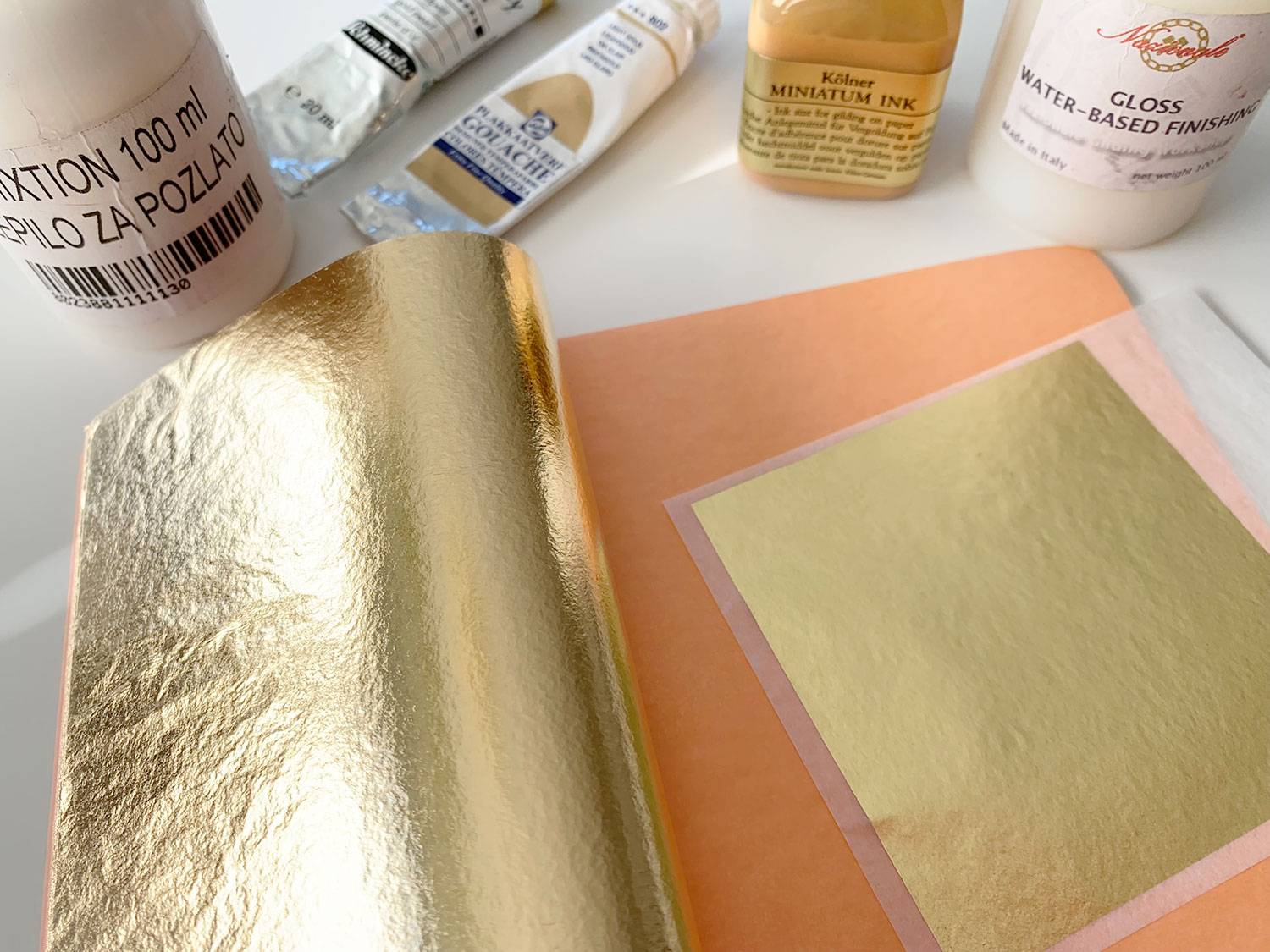
Gold gilding and glue sticks.
Glue for gilding
Gold leaflets placed on top of a pre-applied special adhesive (Gesso, Gum ammoniac), which can be used to create a flat or raised effect.
Tools for gilding
Illumination also requires some additional tools such as a brush to remove excess gold and a polishing tool; this is a handle with agate or hematite.
Procurement of materials
You only need the basic tools to start calligraphy. With time and experience, purchase additional materials according to the style of calligraphy you want to master.
- Calligraphic paper
- Calligraphy pen
- Calligraphic handle, straight or oblique
- Calligraphic ink or colour
For drawing auxiliary lines:
- Ravnila
- Svichnik
- Radirko
Once you understand the rules, you can replace line-drawing with online with a sharpie (e.g. guideline generator) or different templates prepared for different products, such as an A4 pencil or for a certain envelope size.

Straighteners and markers for line drawing.

Calligraphy handle and pen for writing addresses on envelopes

Calligraphy accessories - lighted writing tablet for writing with a cursive pencil
The art is in your hands
Calligraphy is an art that connects you to the past, but also allows you to create something unique in the present moment. With every stroke of the pen, you dive deeper into this magical world where the sky is the only limit.
I can say with certainty that calligraphy will not leave you indifferent, so you will want to try more and more techniques, which will also require more and more different materials. There is no specialised shop in Slovenia specifically for calligraphy. Art and hobby shops do have a few items, but in my experience they are also priced for the end consumer, i.e. for occasional writing.
Do not buy calligraphy sets, which have ink, a beautiful handle, a few nibs and even a drinking fountain, because these are the most expensive, but mostly for decorative purposes only. If you are more serious about calligraphy, I recommend shops where you can get an extra discount for larger quantities, or where their prices are a bit lower to begin with.
Digital calligraphy tools
Calligraphy is not behind the times. Works well with digital tools. It can be created in the traditional way and digitised later, or it can be created using digital tools. This is mainly used when the template is intended to be printed in multiple copies or transferred to larger formats. So you can have a vinyl lettering on your car. I use a combination of graphic design and digital calligraphy to create a beautiful inscription.

Digital calligraphy, which requires the same rules, correct pressure exchange and inter-line relationships. Just like calligraphy on paper, I write it digitally using marker pens.
Why is writing important?
In the digital age, when everything is a click away, we often forget the importance of handwriting. Writing activates the brain, stimulates concentration and allows us to connect more deeply with words. In addition, handwritten words, written with heart and soul, can be therapeutic and liberating. Learning calligraphy is like a journey where every curve, every line and turn tells a story.
Before you dive into the world of shopping, make sure you know what you're looking for. Never underestimate the importance of research. Check out the different styles of calligraphy, research the pens needed for each style and, of course, ask about the prices of courses and literature.
Why learn calligraphy?
Learning calligraphy has many positive attributes and benefits that affect different aspects of our lives:
- Improving brain activity: Writing activates the brain, stimulates concentration and allows us to connect more deeply with words. By stimulating neural circuits, writing can increase cognitive function, creativity and problem-solving skills.
- Improving memory: Studies have shown that handwriting can improve memory and recall of information learned through note-taking. Engaging motor and cognitive processes helps to 'encode' and store information more efficiently than typing or reading.
- Personalisation of other projects: Calligraphy skills and handwriting practice can add a personal touch to your projects, notes and written texts. By developing your own style, you can create unique and memorable creations in your work or hobbies.
- Motor skills: Learning calligraphy and practising handwriting can improve your fine motor skills, eye-hand coordination and manual dexterity. These skills are important not only for writing but also for other tasks that require precision, such as drawing, painting or playing an instrument.
- Meditation: Practicing calligraphy and handwriting can be a meditative activity that promotes relaxation, mindfulness and concentration. If you concentrate on the strokes, shapes and rhythms of the letters, you can enter a state that calms your mind and reduces stress.
- Artistic expression: Calligraphy and handwriting can also be a form of artistic expression that allows you to explore your creativity, style and personality. Whether you prefer traditional calligraphy styles or modern handwriting trends, you can find a way to express yourself through the beautifully written word.
Calligraphy, ADHD and PTSD: Creative Therapy for Better Health
Learning calligraphy also has positive effects on children with Attention Deficit Hyperactivity Disorder (ADHD) and Post Traumatic Stress Disorder (PTSD). Studies have shown that calligraphy improves attention, sensory-perceptual acuity, cognitive and rational abilities, emotional stability and self-control. Calligraphy practice can help children with ADHD to improve concentration and reduce hyperactivity. Calligraphy also has a therapeutic effect on children with PTSD, reducing symptoms of hyperactivity and improving overall emotional stability. You can read more about this in the following studies:
- Dovepress - Effect of calligraphy training on hyperarousal symptoms for childhood (Dove Med Press).
- Lupine Publishers - Calligraphy Treatment of Children with ADHD: A Case Study (Lupine Publishers).

Calligraphic materials Photo: Zlatka Trstenjak Rampre



No Comments