


Calligraphy - a brief history of fine writing
What is calligraphy?
Calligraphy is a form of visual art, involving the use of various calligraphic pens, brushes and other materials to recreate and imitating ancient scripts, but can also include digital tools and can be classified as state-of-the-art art-making techniques. Like any work of art, it is created by hand, uniquely, intimately. Unlike printed text, no two fonts are exactly the same. In the age of digitalisation and artificial intelligence, calligraphy as a leisure activity offers a creative escape, while at the same time providing creators with digital tools to integrate this art and intertwine it with contemporary design.

Calligraphy on the envelope - handwritten address. Calligraphy and visualisation by Zlatka Trstenjak Rampre
When you imitate ornate Celtic script, you are following in the footsteps of ancient scribes whose dream was to create a legacy that will be treasured by generations to come. Learning calligraphy is not only fascinating, it's also a lot of fun and a lot of fun. Calligraphy can be used for lots of interesting projects:
- For decorating walls or other surfaces in the form of inscriptions or calligraphy.
- For creating invitations, greetings, signs, boards and personal messages.
- To add a unique and elegant touch to any gift.
- As a form of self-expression or meditation.
- Calligraphy can also be used to create a computer font - typography.
- Calligraphy can also be digitised and transferred to a wide variety of products.

Calligraphic sticker - mandala - created with calligraphy, digitised. Calligraphy and visualisation by Zlatka Trstenjak Rampre

T-shirt with Slovenia written in calligraphy - made by hand. Calligraphy and visualisation by Zlatka Trstenjak Rampre
Calligraphy is the art of writing, which we also call, for short "beauty". The name is derived from Greek and refers to the words κάλλος kallos (beauty) and γραφή graphẽ (writing). It is ancient, a fascinating craftsmanship, which improves concentration and enhances the ability to visualise, while also presenting a great technical challenge. Calligraphy is about putting strokes into letters, letters into words and then into text. Each calligraphic script has its own characteristics, and is taught by taking into account the rules of each individual font.
The example below applies to Copperplate font showing how many lines are needed for one line of writing.Calligraphers mark the height, proportions and slant of their lettering for practice. Only by understanding line pens do we know how to use them, buy them or create them through online apps.
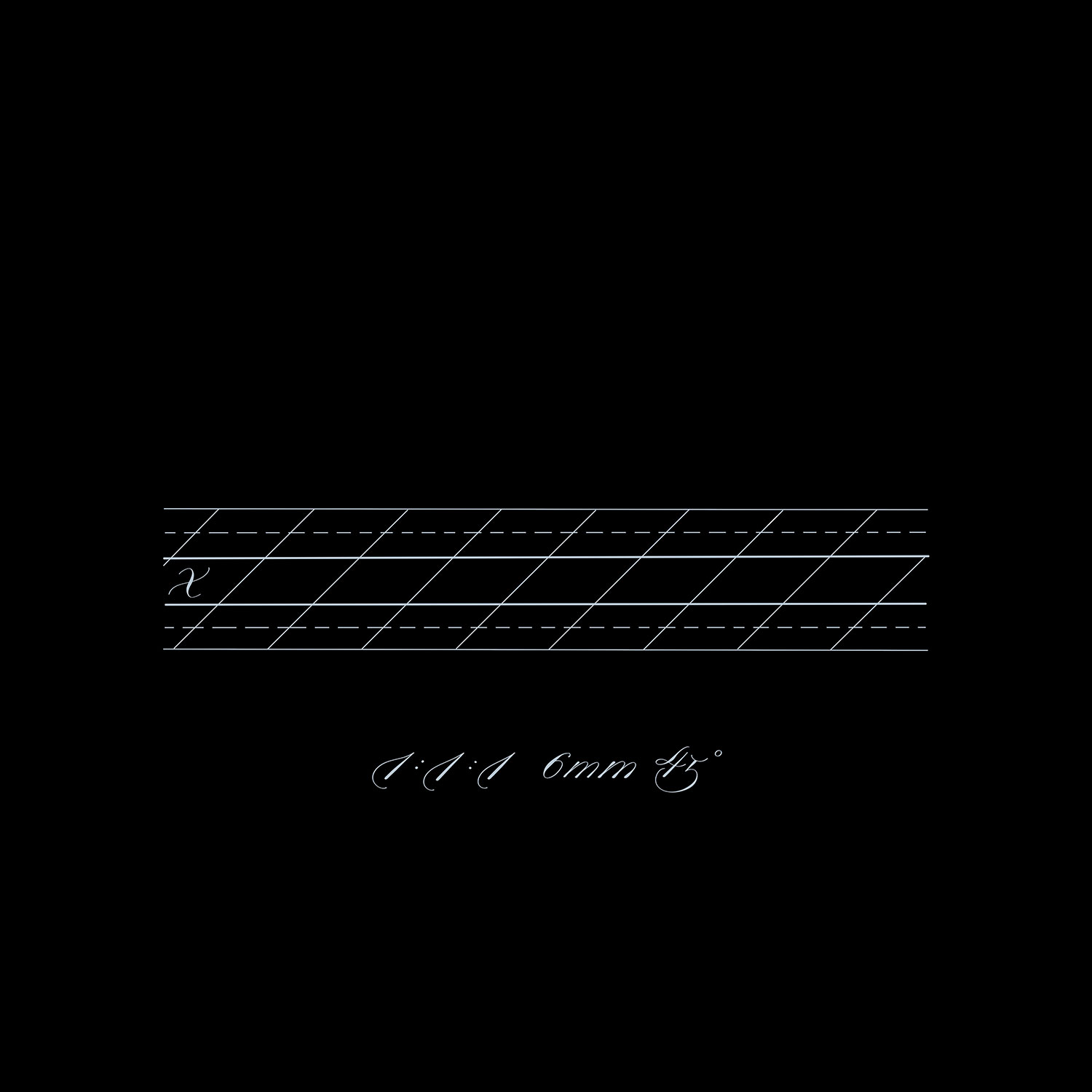
Cursor or guidelines for Copperplate font
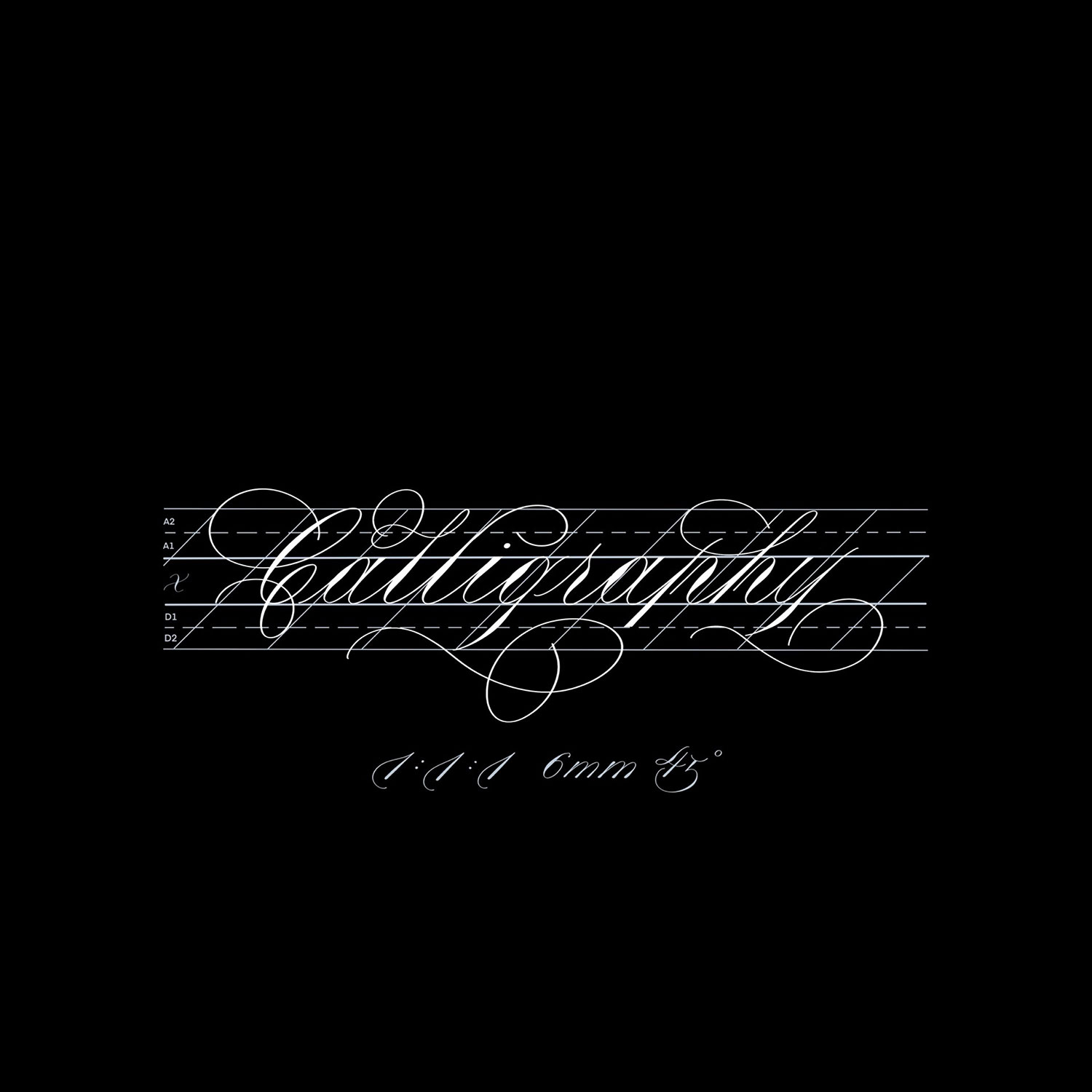
The picture above shows a cursive with the word Calligraphy, clearly indicating that it's not just about beautiful handwriting, but about following the rules. Calligraphy and visualisation by Zlatka Trstenjak Rampre

Scribbling - this is what the decorated Copperplate looks like when you're done writing, the ink is dry and the lines are aligned. Calligraphy and visualisation by Zlatka Trstenjak Rampre
To appreciate the letterform as we use it today, we need to understand the origin and evolution of fonts, woven from Sumerian pictograms, Greek hieroglyphs, Chinese characters and also the first alphabets. History of pictorial symbols ˗ pictograms and cave paintings ˗ dates back 20,000 years to the Early Stone Age. The most significant finds are located in the complex the Lascaux underground caves in France and the Altamira cave in Spain.

Calligraphy Copperplate worksheets for daily practice. Calligraphy and visualisation by Zlatka Trstenjak Rampre
Calligraphy has existed for centuries
Calligraphy was primary form of communication.
In today's world calligraphy is treated more as an art form and less than the way we communicate. There are many different styles of calligraphy and each has its own unique beauty. If you are interested in learning more about this art form, Continue reading. We will explore the history of calligraphy and the best-known Latin scripts.

Book Mastering the art of Calligraphy Photo by Zlatka Trstenjak Rampre.
What are the most famous calligraphic scripts?
The fonts can be divided into three groups, namely:
Latin fonts:
- Karolinska minuscule
- Roman capitals
- Unciala and polunciala
- Gotica (Blackletter)
- Italica
- Copperplate
- Spencerian
Non-Latin fonts:
- Ancient Greek script It was used extensively throughout the Byzantine Empire and is still used today in many Eastern Orthodox churches. The Greek alphabet consists of 24 letters, all of which are written in capital letters.
- Russian Cyrillic was designed in the 9th century for the first Slavic literary language, Old Slavic, initially as an old version of the Bulgarian alphabet, but from the 10th century it came into use in Kievan Rus to write what later became the Russian language.
- Arabic is the third oldest script, dating back to the 6th century AD. It was widely used throughout the Islamic world and is still used in many Muslim countries today. The Arabic alphabet consists of 28 letters, all of which are written in cursive script.
- Hebrew is the fourth oldest script, dating back to the 10th century AD. It was used mainly in ancient Israel and is still used by Jews all over the world. The Hebrew alphabet consists of 22 letters, all of which are written in capital letters, capitals.
Pictogram fonts or alphabets:
- Chinese calligraphy is one of the oldest forms of calligraphy, known for its use of brush strokes to create intricate characters - letters.
- Japanese calligraphy uses brushes to create beautiful pictograms or characters, but the characters are usually simpler than in Chinese calligraphy. Japanese calligraphy is also often used to create tattoos.
Western Calligraphy - Western Calligraphy
It is the calligraphy of the Latin writing system and, to a lesser extent, the Greek and Cyrillic writing systems. Hundreds of thousands of manuscripts were produced in the Middle Ages: many were illuminated - decorated with paintings of animals and enriched with gold.
Christian churches have encouraged the development of writing through the prolific copying of the Bible, especially the New Testament and other sacred texts. Monks in the British Isles adapted the Late Roman script Uncialo to develop a unique script called "Celtic" or "Insular", meaning "of the islands". From the seventh to the ninth centuries, Celtic illuminated manuscripts dominated northern Europe, exemplified by the 'Lindisfarne Gospel' and the Book of Kells.
1. Unciala
It developed around the fourth century, or even a little earlier. She is a majuscule, which means that it is composed entirely of capital letters or capitals.
The early versions could be written quickly, but the later versions, written from the seventh to the ninth century, became more complex and required twists and manipulation of the stylus, which slowed the writing down a bit and required a bit more concentration.
This font is somewhat flat-round and beautifully pressed, so it can be nicely complemented with a versal or ornate initial to develop the texture of the calligraphic work. Suitable for longer texts where no detailed reading of the text is required and the work is mainly of a decorative naturebut can also be used on receipts, certificates and thank-you notes to print the recipient's name and achieve a beautiful contrast even on pre-printed documents.

Calligraphic script Unciala. Book Mastering the art of Calligraphy Photo by Zlatka Trstenjak Rampre.
2. Karolinska minuscule
Charlemagne helped spread beautiful writing in the eighth century. In order to unify the writing of Western Europe, his decree was issued, requiring that the Karolina applied to all existing literary works, legal documents and ecclesiastical services.to bring Alcuin, Abbot of York, to his capital Aachen. Alcuin undertook a major revision of all styles and developed a new manuscript, named after his patron Charlemagne.
It was the first widely used and recognised minuscule. It is slightly round and the font is a little wider. The words have energy and qualities italics. It is elegant and fluid. The capital letters accompanying the minuscule are borrowed from the Roman capitals, but are 5 to 5 pen widths high... For a better rhythm of the product, it can be complemented with the Roman capital and the is also easy to read.
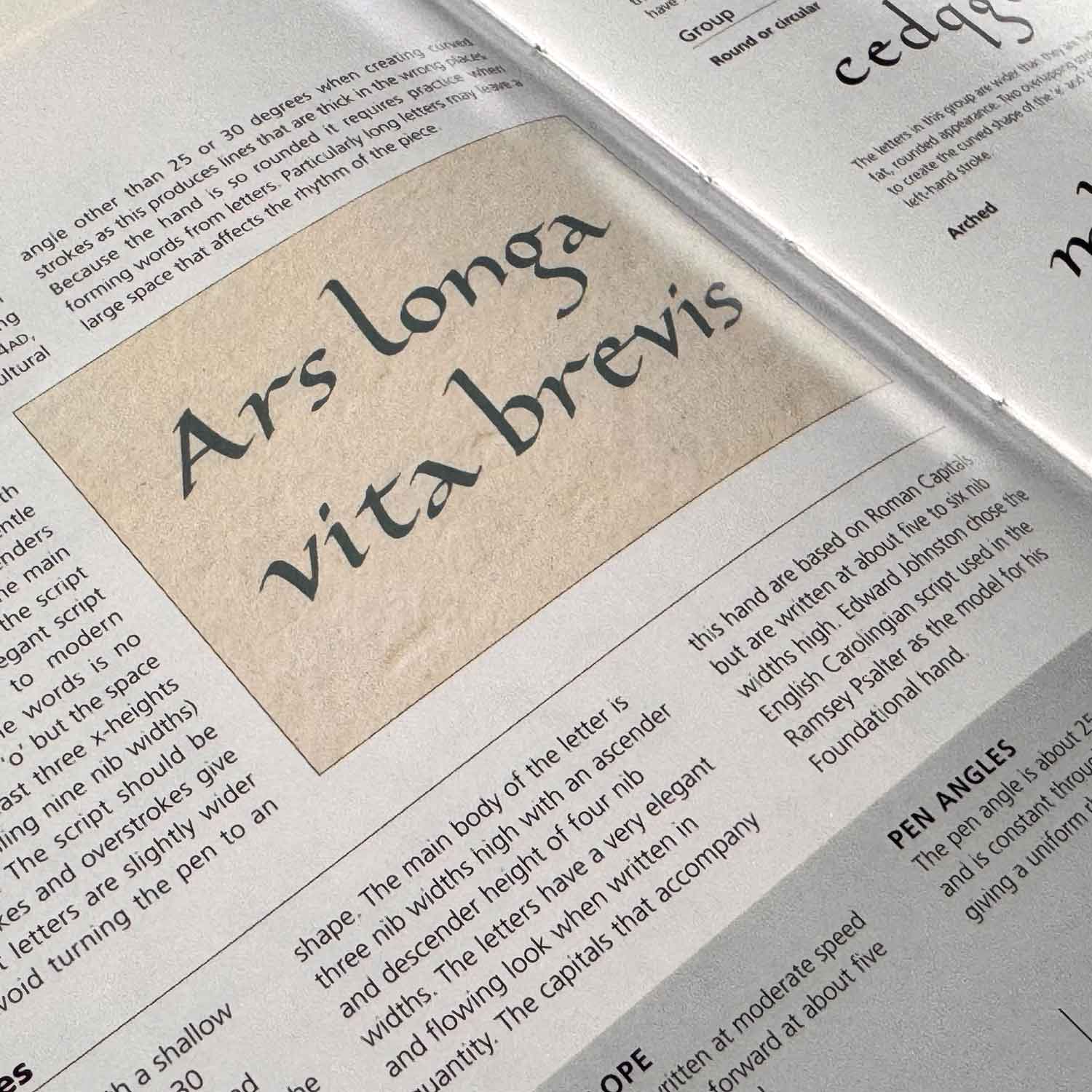
Calligraphy - Caroline minuscule. Book Mastering the art of Calligraphy Photo by Zlatka Trstenjak Rampre.
3. Gothic and its Rotunda version
In the tenth century, the increased demand for manuscripts required a change in the in writing speed, the Karolinska minuscule had to change as a matter of urgency. The demand for more text in a smaller space led to the letters becoming angular and compressed.
Gothic and Rotunda evolved from the Carolingian minuscule in the 12th century. Over the next three centuries, scribes in northern Europe used an increasingly compressed and square form of the Gothic. Those in Italy and Spain preferred the slightly rounder, but still heavy Rotundo.
The wide, angular typeface has become valued for its visual appeal. The Gothic script appeals in all its variations, as it has a strong decorative impression. It interacts beautifully with the delicate and legible Italics where the element of illegibility is dissolved.
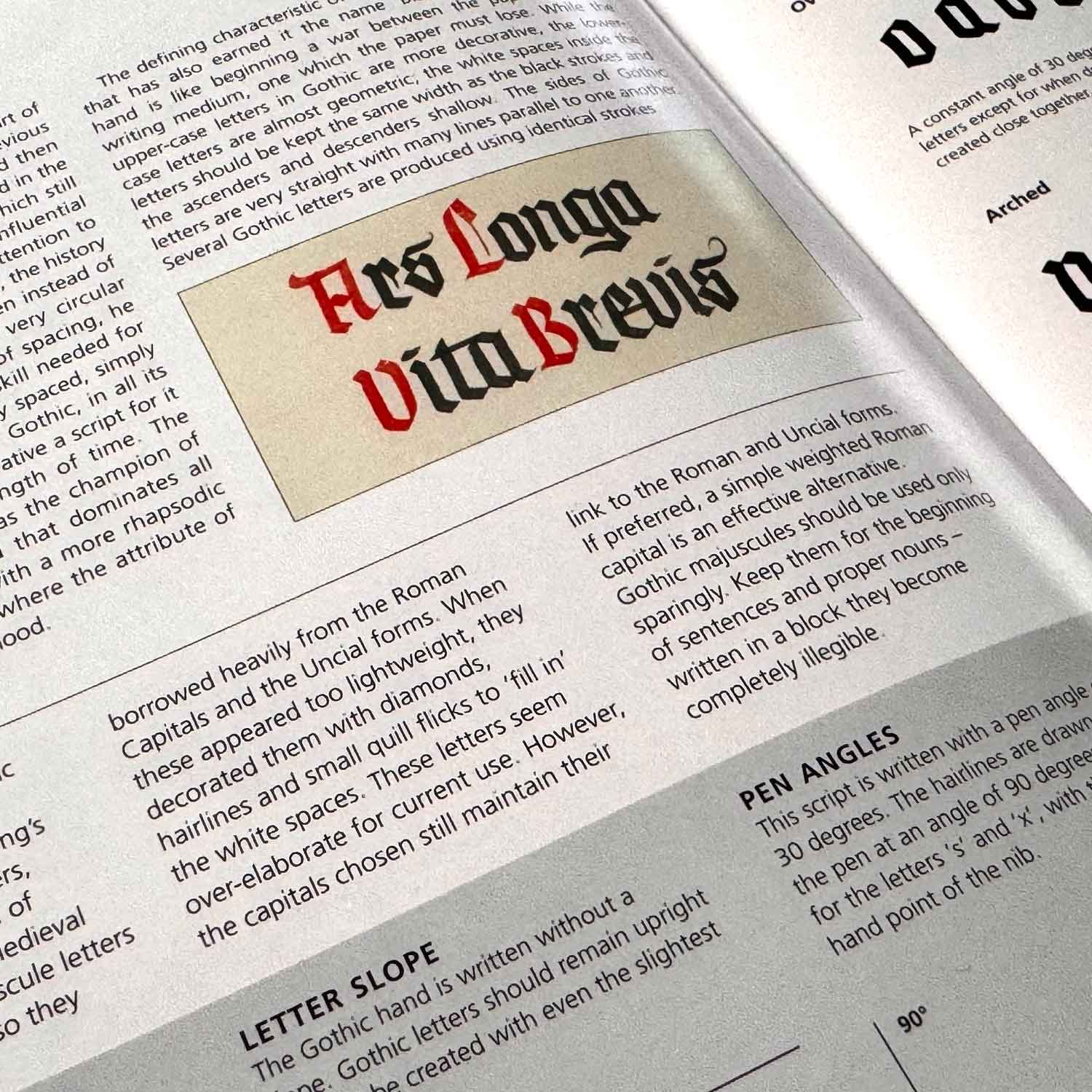
Calligraphy - Gothic. Book Mastering the art of Calligraphy Photo by Zlatka Trstenjak Rampre.
4. Italics
Calligraphic font with a right gradient or italic. To a large extent based on the humanistic minusculewhich itself relies on the Carolingian minuscule. The capital letters are identical to the humanist capitals, following the example of the Roman square capitals. Italian scholar Niccolò de' Niccoli was not happy with the lowercase humanist minuscule, as he found the style too slow to write. In response, he created italic, which incorporates features and techniques that are characteristic of rapid writing. The most important change was the shape of the letter a, which he simplified from a two-storey form to a single-storey form ⟨ɑ⟩, which is now common to most manuscripts.
Influenced by the floating movable type used in printing presses, the style of handwritten floating type has shifted towards disjointed, more polished characters. Until 1550, Italica became very tiresome, so scribes stopped using it.
The style was influenced by the development and use of copper engravings in the eighteenth century. The italic style used today was influenced by developments in the early 20th century. In the last few decades, italic has been promoted in English-speaking countries as an easier-to-learn and alternative to traditional cursive styles.
Italics are still in use today, it is popular for quotations, wedding invitations, artistic calligraphy and improving handwriting style. It is very legible and fits nicely with the Copperplate font on certificates or awards.
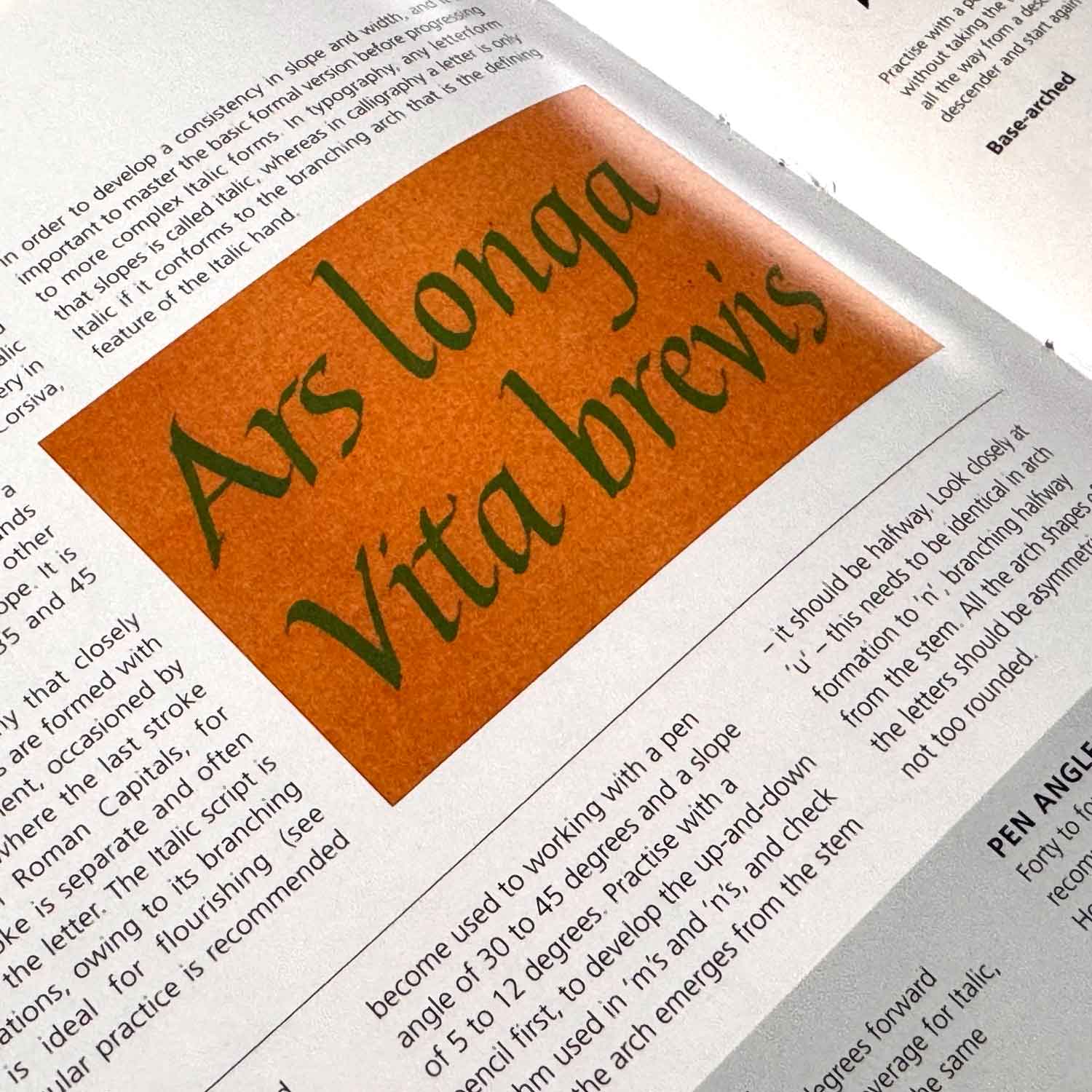
Calligraphic script Italic. Book Mastering the art of Calligraphy Photo by Zlatka Trstenjak Rampre.
5. Copperplate
Copperplate family covers a variety of in pointed nib, including z English Round Hand, English Round Text, Running Hand, Italian Hand, Spencerian, Ornamental Penmanship, Business Penmanship, Engrosser's Script, Engraver's Script, American Roundhand, Modern Calligraphy.
These styles of writing have common roots and were written with pointed flexible pens. They have evolved over time, influenced by changing writing tools and social needs, making this a challenging but fascinating study in the history of calligraphy.
In the 17th and 18th centuries, professional scribes were faced with the challenge of mastering different styles of handwriting, each of which was associated with specific functions. Business documents have requested one style, private correspondence Second, legal documents of a third. In addition, each country had its own national writing styles, often incomprehensible to foreigners.
During this period, Europe boasted stunning 50. different font styles, which made it skilful writing is a rare skill, achieved only by the best masters of writing.
But as the demands of modern business have grown, the manuscript had to be made more accessible and favour simpler and faster styles.
According to Dr Joe Vitolo (founder of IAMPETH.com) Copperplate has become the term used in modern calligraphic circles for a whole range of scripts derived from an 18th century style called English round hand. Some modern definitions - including Wikipedia - also state that "Copperplate" refers to all styles of calligraphy with a pointed nib.
It is an American twist on the old English script Roundhandwhich is so beautifully presented in George Bickham's book The Universal Penman, which presents three styles that are quite similar.
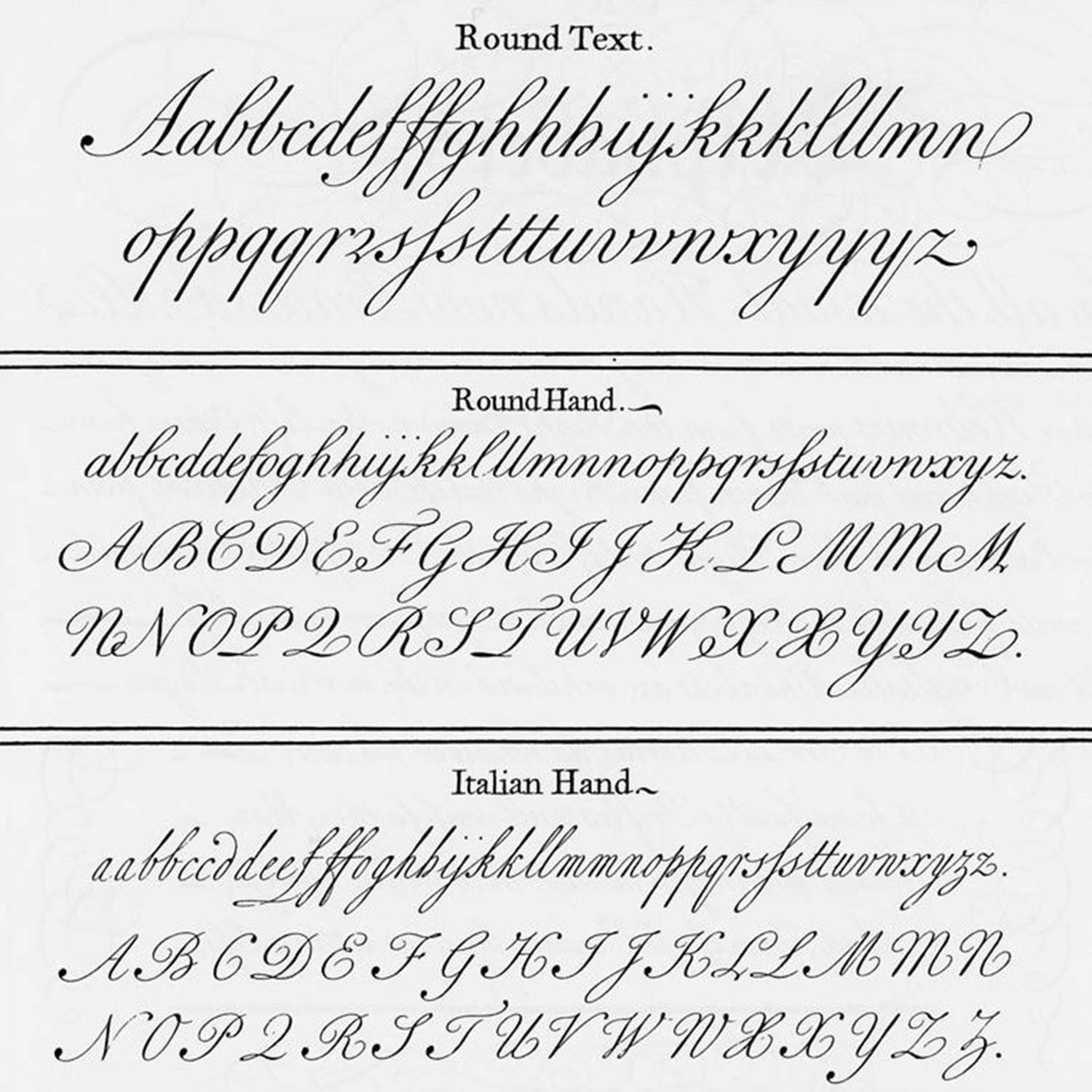
Round hand - George Bickham, Universal Penman, 1741.
Why calligraphers switched from Round Hand at Copperplate?
One reason may be that the style of the Round Hand a common term after the Renaissance, while other nations had their own names for similar styles. The French had Ronde, the Spanish called it Redondilla. Then, at the beginning of the 20th century, Edward Johnston introduced the Foundational Hand, called the Round Handwhich replaced the British Raound Hand.
However, Johnston and his followers used the "Copperplate"to suggest that the old Round Hand worse. The name Copperplate derives from the copper engraved plates that were used when printing presses appeared, not the original hand-lettered designs.
This led to the name Copperplate having a somewhat negative connotation among calligraphers in the 20th century. While some appreciated its charm, many considered it decadent and out of place in the world of calligraphy.
The use of the term "Copperplate" is the generally accepted umbrella term for all styles written with a pointed nib. However, calligraphers should strive to distinguish between these styles and use the correct names whenever possible.
Today, these styles of writing are nostalgic and romantic, suitable for wedding vows, letters, love poems, vows and elegantly spelled names adorning table settings.

Wedding invitations with the addition of calligraphy - decorated Copperplate (English.: Flourished Copperplate). Calligraphy and visualisation by Zlatka Trstenjak Rampre
6. Spencerian
Typeface developed by Platts Roger Spencer in 1840 and soon afterwards began to be taught in school, as Spencer had set it up specifically for that purpose. She was fast and legible and particularly suitable for business correspondence and elegant personal letters. Spencer was inspired by the smooth shapes of the pebbles in the brook and strived to develop a smooth and flowing elegance. Spencer never enjoyed great success, as he had already died.
Thanks to his sons, however, the script became standard in the United States with the previously unheralded Spencerian Key to Practical Penmanship, until the introduction of the typewriter. In primary schools, it gradually replaced the The Palmer method after Austin Palmer, which represented a simplified style of Spencerian script. Palmer's method also had a successor, namely Zaner-Bloser.
There are many more calligraphic scripts, and there is also a lot of literature to learn them.
How can calligraphy be used today?
S Calligraphers it's like with poets. If poets are craftsmen who forge beautiful verses out of verbal material, providing a pleasant musical accompaniment, then calligraphers add structure to these verses. And so the verses, created by hand, suddenly are adorned with an almost fairy-tale beauty.
Contemporary calligraphy is used in different ways today. It is excellent for wedding invitations, business cards, or even as an art form. Some use it for personalisation of gifts, greetings or also corporate gifts. With calligraphy, some they write on naked bodies, others decorate again the whole building. Our calligraphy also adorned a real cake, engraved make a great gift and can be found in the regular available at.
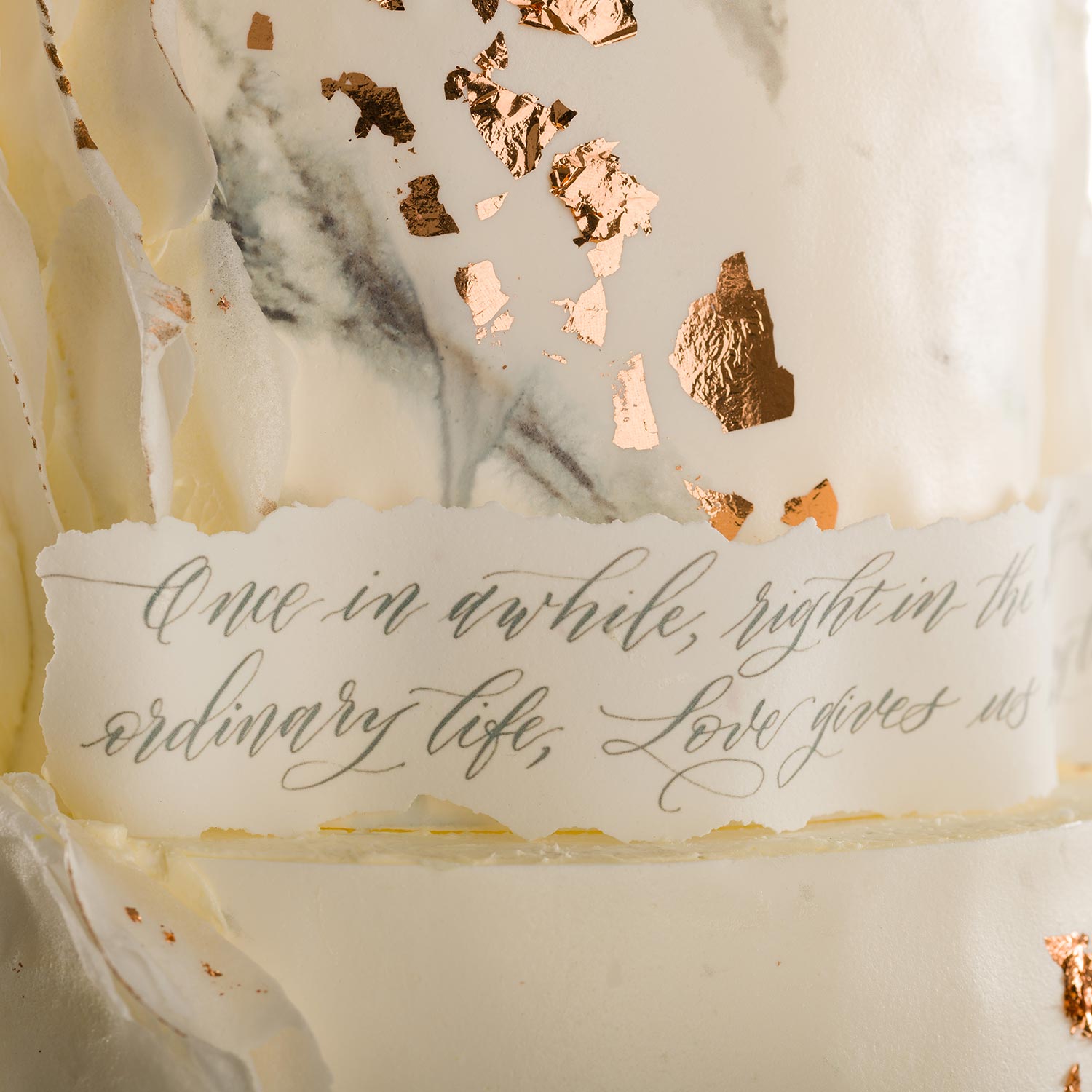
Wedding cake with quote. Calligraphy by Zlatka Trstenjak Rampre Photo Janez Marolt
There are many types contemporary calligraphy. Some artists use traditional calligraphy pens on paper while others use digital tools. Handwritten calligraphy is also now often digitised and as such can be used for large print runs or promotional products without losing its uniqueness.
One popular use of modern calligraphy is creating wedding invitations, inscriptions or monograms. Calligraphy can also be used for branding purposes. Many companies use calligraphy to create logos and other materials. One of trend-setting procedures, who are skilled in calligraphy, is engraving. Engraving is the form of permanent decoration of the product and sculpting the design into the surface itself.
Modern calligraphy can be used in many different ways. Whether you are looking for a unique way to add a personal touch to your materials or want to create a beautiful piece of art, modern calligraphy is perfect.
Calligraphy at a wedding
Calligraphic details can adorn envelope, invitations, menus, seating, wedding signboards, mirrors with guests' names, table numbers and thank-you notes. Calligraphy can be added to your wedding stationery to add an elegant and personal touch to your event. For example, couples can choose to have their names printed in real calligraphy on their invitations. So connect modern technology with ancient art and create something extraordinary.
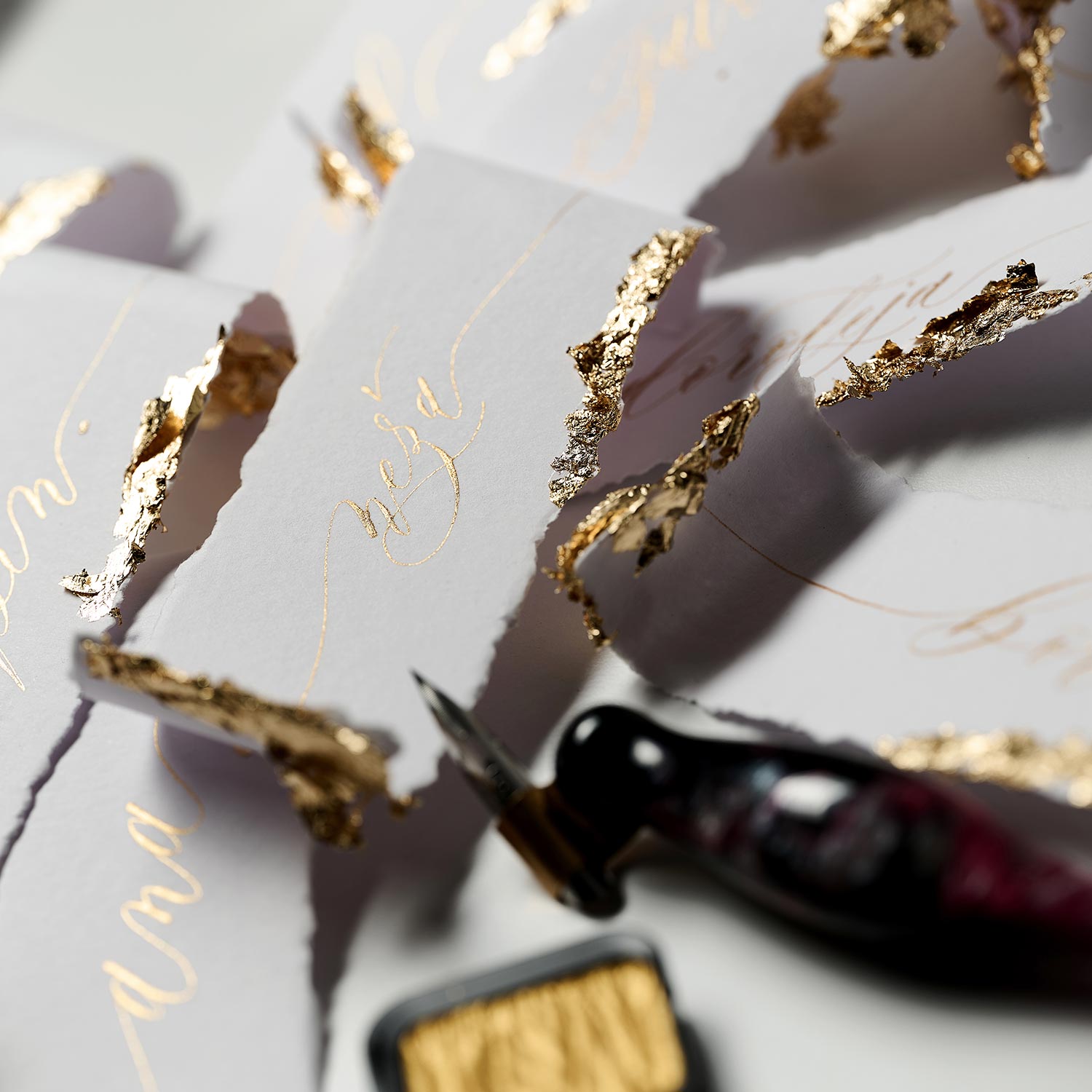
Calligraphy for wedding. Calligraphy by Zlatko Trstenjak Rampre Photo Blaž Žnidarščić
Why is calligraphy so expensive?
There are several reasons why calligraphy is more expensive than other types of printed matter.
First, tools, required for calligraphy are specialised and much more expensive than a regular fountain pen or ballpoint pen.
Secondly, calligraphy takes much longer to produce than normal writing, so the cost is higher. Learning calligraphy is time-consuming and demanding. It requires a lot of perseverance and the positive results may not be immediate if it is not practised regularly.
You know what they say: "Practice makes perfect, if perfect makes perfect."
After all, it is a very specialised skill that fewer and fewer people know, as even primary schools have long since abandoned the subject of beauty.
With growth wedding industries interest in modern calligraphy. The term modern calligraphy a style of calligraphy which does not follow the basic rules of traditional calligraphic scriptssuch as Copperplate, Spencerian, Italic, Blackletter, etc. Modern calligraphy is based on certain principles of traditional calligraphy, but a modern style really gives you more creative freedom. It is definitely necessary to master the rules of a particular script first, and then to modernise the script a little, then to develop a unique style of your own.
Calligraphy is also combined with other artistic styles, often including gilding or gilding. Gilding with real gold leaf is a demanding process and is suitable for longer texts that adorn walls.
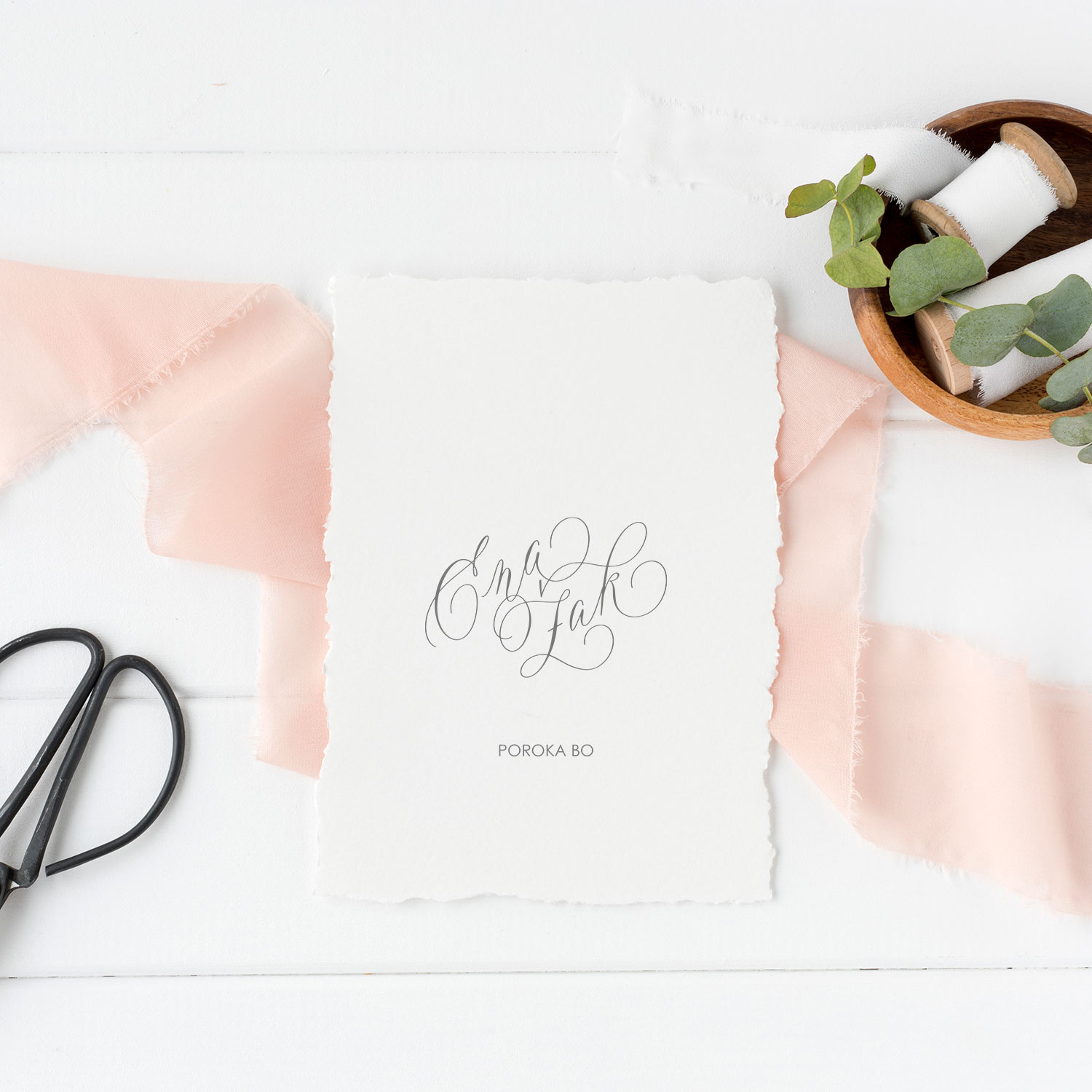
Wedding stationery is at its best when it combines legible typography with the addition of modern calligraphy to create the names of the wedding couple. Calligraphy and visualisation by Zlatka Trstenjak Rampre
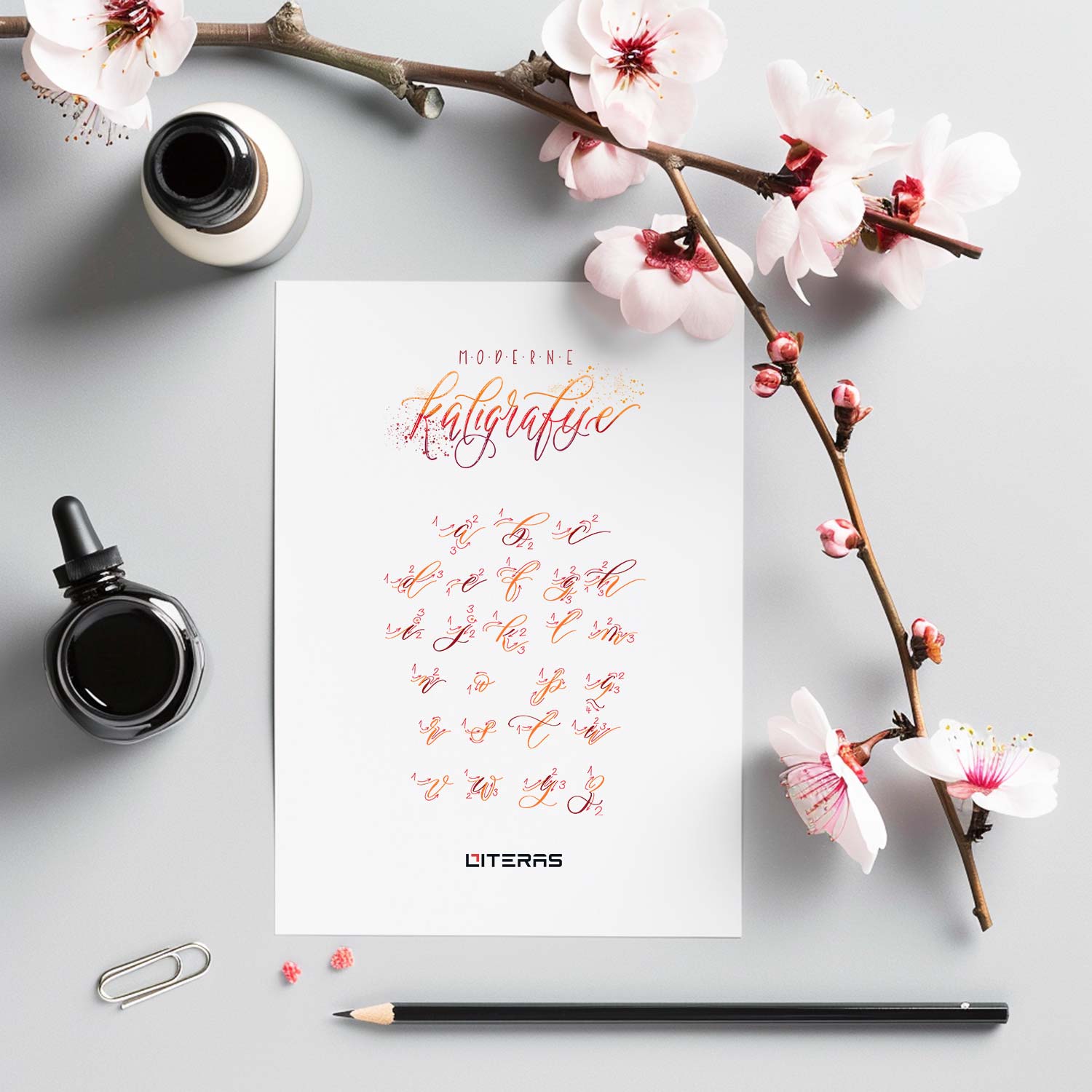 Modern calligraphy with arrows to help you write. Calligraphy and visualisation by Zlatka Trstenjak Rampre

Calligraphy materials: watercolour paints, pen holders and various calligraphy pens, inks and colours in tubes and gold leaf are indispensable for creation. Photo by Zlatka Trstenjak Rampre
Sources:
Ralph, C. (2006). The Complete guide to Calligraphy. London, England.
Drogin, M.(2015). Medieval Calligraphy, Its history and Technique. New Jersey, USA: Library of Congress Cataloging-in-Publication Data.
Mehigan, J. (2006). Mastering the art of Calligraphy. Annes Publishing Ltd.



No Comments